After the Deckchairs Go: A Family’s Hour on the Night Beach
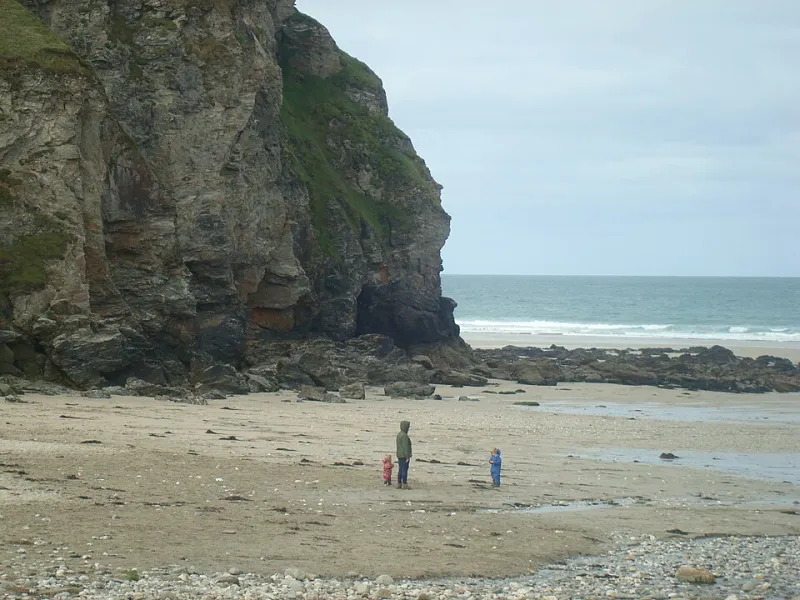
Photo: cynthia hudson , CC BY-SA 2.0, via Wikimedia Commons
The beach after sunset is not a bigger, darker version of the daytime beach. It is a different room. The sand goes cool underfoot, the horizon dissolves, and the things children notice change completely: a flashing light far out at sea, the rattle of shingle, the first star above the car park. You do not need an expedition to enjoy it. One hour, done properly, is plenty.
This is not a case for turning a family evening into a minor polar expedition. It is a case for a small, well-judged visit — the kind that ends with everyone warm in the car rather than everyone cold and cross on a slipway. The difference is mostly preparation, and a willingness to leave earlier than you think you should.
Choose a beach that forgives a wobble
Start with the sand, not the stars. A night beach with children wants wide, level ground, a simple route in and out, and as few surprises as possible between the car and the tideline. Think long, flat sands rather than rocky platforms, boulder fields or steep cliff paths. Somewhere like a broad Norfolk beach or a gentle Cornish bay works far better after dark than a cove with a slippery slipway and a dozen trip hazards.
Avoid estuaries, causeways and beaches with fast-filling channels. Avoid anywhere that requires scrambling over rocks or walking below cliffs. In daylight these are interesting; in the dark they are simply a way to turn a nice evening into a call to the coastguard. If the access is complicated, save it for a summer afternoon.
It also helps if you have been there before. Familiarity is a safety aid. You know where the steps are, where the dog walkers come from, roughly how far the water goes out. If you are trying somewhere new, arrive before sunset and walk the short route you plan to use later. Then you are not navigating in the dark; you are just returning.
The tide is still the clock
Darkness does not pause the sea. Check a proper tide table for the exact beach — not the nearest big town, not a generic app that rounds everything to the nearest hour. Note high water, low water and the direction of travel. On a big spring tide, the difference between the water’s edge and the car park can shrink alarmingly quickly.
A useful habit is to set a phone alarm for 30 minutes before you intend to leave. Not because the tide will instantly chase you up the sand, but because children are excellent at extending a good thing. The alarm is for the adults. It gives you time to gather the flask, the gloves and the child who has just found an interesting piece of seaweed.
Do not rely on the sea being where it was when you arrived. On a wide beach at low water, the incoming tide can look slow and harmless from a distance and still cut off the route back around a headland. Keep your exit behind you, not across the water. If in doubt, stay high on the beach and watch from there.
Kit that earns its place
You do not need much, but the things you do need should be boringly reliable. Warm layers beat fashion every time: an extra fleece, a waterproof shell, hats and gloves, even in what looked like a mild afternoon. The temperature drops faster on open sand than it does in the street. A thermos and a few substantial snacks will do more for family morale than any gadget.
Lighting matters more than most people expect. Bring a head torch each, plus a small hand torch, and spare batteries. Red-light modes are useful for preserving night vision and for not dazzling everyone else. A phone torch is better than nothing, but it eats battery and ties up the hand you might need for holding a child. Keep phones charged and bring a power bank if you are relying on one for maps or tide checks.
Add a basic first-aid kit, a reflective strip or two on bags and coats, and a charged phone with a location app such as what3words or OS Locate. Tell someone where you are going and when you expect to be back. It sounds fussy for an hour on the sand. It takes two minutes.
What children actually notice
Once the light goes, the beach becomes a place of small events. Distant shipping lights slide along the horizon. A lighthouse flashes on its steady rhythm. Aircraft cross high overhead, and satellites can be spotted moving quietly between the stars. On the right night, with a dark sky and no moon, there may be phosphorescence in the water — a blue-green sparkle in the breaking waves caused by tiny marine organisms. It is never guaranteed, which is part of the appeal.
The sounds are just as good. Shingle shifting, water draining through sand, the low murmur of a ferry. Children who race about in daylight often slow down after dark. Give them a job: count the lights, listen for three different sounds, find the Plough, watch for the first star. A small torch and a patch of wet sand can turn into a gentle rockpool session, as long as you keep away from slippery rocks and the incoming tide.
The safety bit, without the lecture
A night beach is not the place for swimming, paddling or rock climbing. Keep everyone well back from the water’s edge, because darkness hides wave sets and the shape of the ground. Stay away from cliffs, dunes with steep drops and any path you have not already walked. Cold is the other quiet risk: children who are shivering are not having fun, even if they say they are.
If something does go wrong, call 999 and ask for the coastguard. Do not wade in after a dog or a bag. Do not let anyone go off alone to find the path. Keep the group together, keep a light on, and move to higher ground if the tide is the issue.
Leave while it is still good
The best night-beach visits end before the whinging starts. Walk back with the torch on the path, not pointed at faces. Get into warm clothes, hand out the flask, and let the last bit of the evening be the car heater and the radio. The beach will still be there next time. You will have taught the children something useful: that the dark shore is worth visiting, but not worth overstaying.